Wednesday, November 5, 2008

AFI Fest 2008: Fast Forward--Day Six

I'm zoomin' back and forth in time on these festival-posts to a near-incomprehensible extent, aren't I? Such is the problem I face in trying to cover current programming that I saw early before I fully catch up with past reviews.

So for those of you who haven't done the math: I've posted all of Day One and Day Two, none of Day Three, some of Day Four, and now Day Six. (I didn't attend Day Five because my eyes were fixed on the election and because only a few low-profile features were scheduled because programmers knew there would be quite a few in my position.)

But I digress. I wanted to cover a film playing tonight before it screens. It's called A Good Day to be Black & Sexy and, no, it has nothing to do with Barack Obama.

The film was written and directed by first-timer Dennis Dortch and consists of five short segments, linked by common themes about African-American sexual relationships in modern America. There's a woman who refuses to reciprocate oral sex when her husband gives it to her, another who is frustrated by her married boyfriend's lack of commitment, a first-generation Asian-American who's scared to tell her family she has a black partner, et cetera et cetera.

A Good Day to be Black & Sexy is effective for about a half an hour--around two segments worth--but it wears out its welcome quickly and becomes episodic. African-American audiences may enjoy the movie more than I did because it was made with them in mind--think Tyler Perry with less religion and more sex--but that doesn't excuse the fact that it's a decidedly mediocre effort. Dortch may be on to something --the multi-story structure admittedly suits his style well--but it's not hugely apparent in the final cut. And not a single performance in the picture stands out as being particularly inspired. Count it a missed opportunity. 2 Buckets out of 4.

A Good Day to be Black & Sexy screens tonight, Weds., Nov 5. at 7 p.m. and Fri., Nov. 7 at 12:45 p.m.

AFI Fest 2008: Day Two, Part 2

Whewwwf. Can you believe it's Wednesday already? I certainly can't... and I don't want it to be, either. Not just because my candidate in yesterday's political horse-race lost, but also because I'm three days behind in my coverage of AFI Fest. Yikes indeed. But no matter. Some of the films I saw over the weekend that I haven't yet written about still have showings left at the festival and many will see theatrical release in near future, so my reviews are no less valuable now than they were a couple days ago.

Turning the time-clock back to Saturday...

Bent Hamer's O' Horten meanders in ways that only a Scandinavian dramedy is capable of. This Norwegian-import very muchwas made in the vein of the work of neighboring-Finlander Aki Kaurismaki, but its attempts at subtle dark comedy and quiet emotional resonance are futile compared to those of the veteran filmmaker. The picture is deliberately anti-narrative, reveling in wide-shots of starkly beautiful ice-filled landscapes set to Kaada's transfixing original score, until it reaches a dreamlike final act in which its newly-retired train-engineer protagonist Odd Horton (Baard Owe) stumbles upon an unlikely friendship (or something like it) late one night in a smoke-shop. Ultimately, the experience doesn't quite gel together, making the viewer wish writer/director Hamer had stuck to the simple and enjoyable wonders of the opening acts and not gone for the opaque whimsy that he does at the end. The film's conclusion is unrewarding because its adherence to the abstract fails to rationalize what has come before it in a moving way, as an unexpectedly logical one may have. Alas, O'Horten feels plodding and a bit empty on the whole, which is a shame given that Owe is terrific in the lead role and the film boasts good production values. 2 Buckets out of 4.

Viewers seeking a more realistic experience should look no further than Olivier Assayas' Summer Hours, an engrossing French drama about grown siblings (Juliette Binoche, Jérémie Renier, and Charles Berling) coping with the loss of their mother by considering the future of their ownership of the home she lived in. Note that I wrote "engrossing" and not "emotional." Summer Hours lacks poignancy because the characters are not relatable everyday people ; they make up the typical elitist, artsy-fartsy French crowd. In one scene, a character resents the decision that the siblings made to give away certain famous art-pieces in the home, a feeling that present financially-burdened moviegoers (at least in the U.S.) will find to be a bit distant from their sympathies. Nonetheless, Summer Hours finds exceptional authenticity in the way the siblings interact regarding the home, which they grew up in and spent countless hours enjoying over summers with their children. Two of them could care less about the house--it holds sentimental value, but this value is less desirable to them than the money they'll bank from selling it--and one sees the need to keep it to stay true to his mother. In this very conflict, Assayas engages in seamless character-development, showing how these people have grown over the years and have become who they are today. There isn't a whiff of sentimentality or manipulation to be found in the exercise, either. While I may not have left Summer Hours touched, there's no reason I should have. This is a movie about families that strives for so much more than the typical teary-eyed melodrama. There was simply no reason for Assayas to explore cliches here because they wouldn't have added anything to the story, and that he realized this is a testament to his measured judgment as a filmmaker. (No, I wouldn't say the same thing about Demonlover, just in case it was bothering you.) Keep an eye out for this film; it's worth seeing. 3 Buckets out of 4; screens again tonight, Weds., Nov. 5 at 7 p.m.

And then there was the big Centerpiece Gala of the night, the first of three during the festival (The Wrestler and Last Chance Harvey are both slated for later this week.)

It's hard to discuss my thoughts on Steven Soderbergh's 4-1/2 hour epic, Che, within the confines of a short 'blog entry, nor to I have any aspirations to. This is mainly because the movie boasts none of the standard markings of a sprawling opus; instead, it's almost exclusively strung together by minor moments. If you were wondering what Che Guevara, the man who is equally praised by leftists for being a heroic revolutionary as he is condemned by moderates and conservatives for being responsible for dozens of brutal murders, was like on a human-level when he camped out before skirmishes in his revolutions in Cuba and Bolivia, then this is the movie for you (or at least Soderbergh thinks it is).

What I found most interesting about Che is how differently I reacted to its two parts. (It was logically split in two primarily for commercial reasons, but there were some artistic differences between the parts like theatrical aspect ratio.) Part one covers Guevara's participation in the Cuban Revolution, from the battles he fought to his relationship with Fidel Castro to the communist principles that led him to participate. It succeeds as a straightforward war film with a uniquely intimate scope, primarily because Soderbergh adheres to detail and doesn't over-glamorize Che. (No, Soderbergh doesn't depict him for the murderer he was, but given the movie is told from Che's emotional-perspective, this is forgivable). The cinematography is sweeping, especially when one considers how good it looks for something shot on digital. And Benicio Del Toro just flat-out disappears into the role of Che, instantly sucking the viewer in.

Part two of the film, on the other hand, is pretty awful. It moves with the pace of molasses, covering the "quieter" moments of Che's attempted overthrow of the Bolivian government years after his efforts in Cuba became infamous. I don't have any problem with this approach in and of itself--in fact, I think Soderbergh's refusal to go for a traditionally epic approach was noble and lends admirable intimacy to the material--but it doesn't work overall because Peter Buchman and Benjamin A. van der Veen's script contains few interesting insights on Che himself. The result is a 2+ hour saga that delves into a completely empty version of a man's psyche. And the final scenes absolutely glamorize Che in an inappropriate manner, with sympathetic POV photography that is as morally-repugnant as it is aesthetically-beautiful. Yes, Del Toro remains as good in part two as he is in part one--I don't believe there was any lapse between the parts in filming, so any difference in the quality of his performance would have been unexpected--but this can't save what becomes a yawn-inducing and arguably offensive finish to what begins as a pretty good movie. What a shame. 2 Buckets out of 4 (part one: 3, part two: 1 1/2); opens in limited release and on IFC VideoOnDemand on Dec. 12.

That's all I've got for Saturday. I caught three movies on Sunday and Monday and will report back soon on those, as well as the 13 others I plan to catch between now and the end of the festival.

Monday, November 3, 2008

AFI Fest 2008: Fast Forward--Day Four, Part 1

First, I must address the obvious question: why has festival coverage shifted from Day Two, Part 1 to Day Four, Part 1? Aren't 'ya skipping Part 2 of Day Two and all of Day Three, Danny?

The answer: yes, you are correct. But not to worry -- the abrupt shift only comes because I have not yet had time to write about my screenings on Days Two and Three (watch for those posts to come late tonight and around midday tomorrow) but want to make sure you are all aware of the big film playing today (Day Four), hence the lack of chronology.

Actually, you're all probably quite aware The Brothers Bloom, directed by Rian Johnson ofBrick fame and starring Mark Ruffalo, Adrien Brody, and Rachel Weisz. It was a big deal at Toronto and it will be very admired in circles when it's released for mass-consumption this January.

I had a chance to see the movie back in late-September at the San Diego Film Festival and, while I don't think it's a masterpiece, I'm definitely fond of the movie. Spinning an imaginative yarn about con-men brothers (Ruffalo and Brody) whose perfect conning record is threatened when they try to pull a fast-one on a charmer who is as rich as she is clumsy (Weisz), Johnson paints a colorful and captivating tale that will remind many viewers of Tim Burton's films. (His work is a lot more inspired here than it was in the overrated Brick, by the way.) And Weisz is absolutely scene-stealing and joyful and grabbing and and...*deep breath* the picture's worth seeing just for her performance. So what are you waiting for? There's still time to head over to the ArcLightand hop into the rush-line--fingers-crossed you'll make it in--for tonight's sold-out show. 3 Buckets out of 4.

The Brothers Bloom screens tonight, Nov. 3 at 7 p.m. and Sat., Nov. 8 at 3:15 p.m.

Sunday, November 2, 2008

AFI Fest 2008: Day Two, Part 1

Before covering the three films I saw on Day Two of AFI Fest--those reviews won't come until later as I have limited time before screenings begin today--I'd like to cover the big movie showing tonight at the festival, which I had a chance to see at a press screening.

Arnaud Desplechin's A Christmas Tale is a movie that will have hardcore art-film enthusiasts raving and everybody else snoozing. Yes, it's true that the movie is pretty darn amazing on a technical level: it tells the story of an extended-family of 15 gathering over Christmas and never loses sight of a single character. Every persona is well-developed and, indeed, the viewer feels like they know each of them. Ice the cake with some lovely cinematography courtesy of veteran Eric Gautier and you've got yourself what would seem like a masterpiece on the surface.

And yet A Christmas Tale is no masterpiece. In fact, it may not even be a good movie. The reason is simple: however well-constructed its characters and situations are, they never connect with the audience on an emotional level. Desplechin's work is so technically competent that it practically begs to be viewed as an exercise rather than the deeply poignant experience that it should be. There is a sense that the filmmaker loses touch with his characters by overanalyzing them; they should be rough around the edges but the film's execution doesn't allow for this.

Desplechin's harmful overzealousness in A Christmas Tale does not just show in the fact that he spends a lot of time indulging in each of his characters. It also rears its ugly head when he structurally implies up-front that the experience will be an greatly emotional one. Desplechin inserts all of the film's conflicts and dramatic meat into the first act of the movie--we learn right away that the family's matriarch, Junon (Catherine Denuve), has been diagnosed with terminal leukemia; that she lost a 7-year-old son decades ago, likely because she passed the disease on; that her next-eldest son, Ivan (Melvil Poupard), became her favorite because he took the deceased's place; and that her youngest, Henri (Mathieu Amalric), will soon be giving her a bone-marrow transplant despite being banished from the family in a legal-agreement by her depressed daughter, Elizabeth (Anne Consigny)--to show that he's going to use the rest of the movie to work on emotional-development. (If that sentence seemed long and complicated, then this movie, which plays like 25 of them strung together, isn't for you.) Oh, and don't forget that A Christmas Tale is indeed about its titular holiday, meaning its frontloaded structure suggests a genre-defying movie in and of itself because, after all, when was the last time you saw a Christmas movie about character-development?

The above represents precisely the irony of A Christmas Tale: it focuses so much on developing its characters and yet the characters never once move the audience. Part of this is because they collectively represent a dysfunctional family and dysfunctional families are rarely involving unless their antics are neurotically funny (forget about touching). But a lot of it is because Desplechin just wants the film to be perfect, which is the antithesis of what his characters are. They should be a family of humans experiencing authentic problems as they come together to celebrate a holiday; instead, they're pawns in an artistically-drunken Christmas movie that wants to make sure you know it's not like the rest of its kind. The result is a motion picture that will leave most viewers yawning well before its cumbersome 152 minutes have passed. 2 Buckets out of 4.

A Christmas Tale screens tonight at 6:45 p.m. with a Tribute to Arnaud Desplechin and again on Fri., Nov. 7 at 7:30 p.m. at the Los Angeles County Museum of Art.

Saturday, November 1, 2008

AFI Fest 2008: Day One

2008's AFI Fest not only represents my second time attending the festival, but my first anniversary of living in Los Angeles. One year ago, I moved into a tiny studio on the fifteeth floor of a monstrous Downtown high-rise... and I'm thankfully still here to talk about it today. While the smog, traffic, and hoards of Angelenos on city-streets can make L.A. a tasking place at times--I often escape back down to suburban San Diego for some peace and quiet on the weekends--I also owe it a great deal of respect. I can confidently say that, if not for L.A., my writing would be weaker and my access to films would be far more limited than they are now.

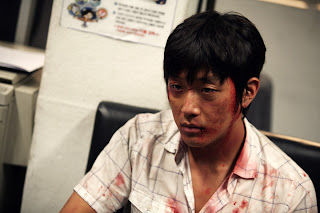
Last year, I began my festival with Chang-dong Lee's Secret Sunshine, a terrific drama/whodunnit that still hasn't seen U.S. release. Make sure to keep watching for it. This year, I decided to start my festival with another Korean film called The Chaser, directed by first-timer Hong-jin Na. I didn't expect much walking into the theatre because I hadn't heard anything about the movie, but I was soon taken by complete surprise when I learned in the programmer's introduction that it competed for this year's Palme d'Or at Cannes. When the movie came up on the screen, I was blind-sided once again. From the first ten minutes, I could tell that it would be one of the most stylistically-enriching exercises in pulp since the one Quentin Tarantino provided us with fourteen years ago.

The Chaser tells the story of a psychotic killer not unlike those in the Saw and Hostel series, who takes prostitutes back to his home only to mame and kill them. The movie isn't your standard torture-porn flick, though; in fact, folks like Eli Roth really should watch it to learn a thing or two from Na's refreshing debut. The story-web cast is complex.

Young-min Jee (Jung-woo Ha) is a regular client of Joong-ho Eom (Yun-seok Kim), an ex-cop-turned-pimp whose call-girls seem to be disappearing on him by the second. Young-min has been killing them, but Joong-ho doesn't realize that the two who have gone missing were both with Young-min until after he dispatches Mi-jin Kim (Yeong-hi Seo) to Young-min's home. Joong-ho thinks Young-min is selling the girls into sex-slavery, which, as he pieces together as the movie goes on, would be a far better fate than the torturous one they're actually suffering. Joong-ho chases Young-min throughout the movie, even catching him very early on only to see a beaureocratic police-force release him because they have no evidence to hold him on. Complicated situations ensue with Mi-jin's single-digit-aged daughter and Joong-ho's assistant (who he calls "Meathead") along for the ride.

The Chaser revels in socio-political commentary on the state of the South Korean police, stomach-churning violence that serves a far greater purpose than it does in the Saw series, well-paced chase scenes with stunning cinematography, a Shakesperean tone of unescapable dread, and the feeling that it is the work of the next great Asian action director. It has its problems, yes, running for about a half-hour too long at 125 minutes, but theyare negligible when one considers what a find it is. I can't think of a better movie I could've seen this Halloween. 3-1/2 Buckets out of 4; screens again Thursday, Nov. 6 at 12:30 p.m.

Also on my list of films to cover today is Margarita Jimeno's Gogol Bordello Nonstop, a documentary delving into the history of the titular gypsy-punk band that has its premiere at the festival tonight. I'm not familiar with the band's music beyond the songs used for film-soundtracks (Everything is Illuminated) or its members beyond the fact that they all appear in Madonna's new bomb of a directing-debut Filth and Wisdom, which explains why I found the doc pretty uninteresting. Beyond familiarizing the viewer with the paradox that is gypsy-punk, Jimeno doesn't delve into anything profound about the band's origins or its purpose, nor does she allow time for any long-passages of concert-footage (I'll admit the music is catchy--"Start wearin' purple / wearin' purple..."). The result is a film that will only appeal to hardcore Gogol Bordello fans. I assume that AFI only programmed it because of the success of a similar niche-music film that sold out three shows at last year's fest, Heima featuring the compositions of Icelandic band Sigur Ros. 2 Buckets out of 4; screens tonight at 7:10 p.m. and Weds., Nov. 5 at 12:30 p.m.

That's all I have for now; I will return tonight or tomorrow morning with three more reviews. Until next time, may the film-going forces of the world force be with you.